
From hours to sub-seconds: AI model allows real-time control of laser welding
Thun, 29.09.2026 — Laser welding is an advanced technique used to manufacture high-quality components for a variety of applications, from space to medicine. Researchers from Empa and the quantum computing company Terra Quantum have developed an AI model to accurately simulate and optimize the complex welding process – in fractions of a second.
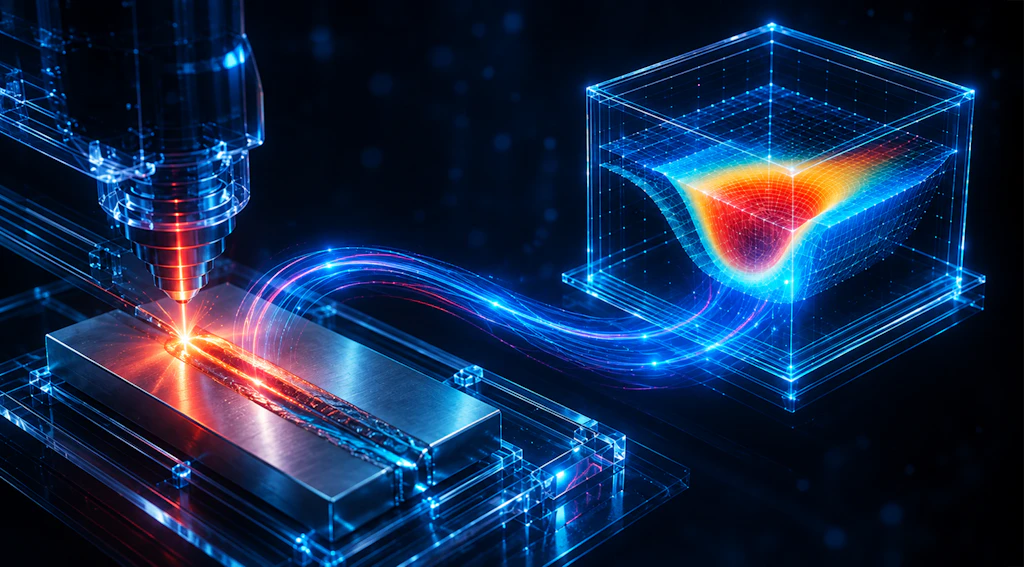
Laser welding is a precision manufacturing process used across aerospace, medical device, and automotive production. The technique is fast, precise, and easy to automate – but the process is complex and difficult to predict, as it couples many different physical effects. The laser melts a pool of metal spanning a few hundred micrometers. Within this pool, temperature-dependent surface tension drives flow; recoil pressure caused by evaporation leads to the formation of deep and narrow cavities known as keyholes. The keyholes then trap reflecting beams of light, locally increasing the absorbed fraction of the laser power.
Physics-based computer simulations are commonly used to optimize laser welding. However, a high-fidelity simulation may take hours to complete, as it entails solving fluid flow, heat transfer, phase change and a moving free surface at once. This makes optimization costly and puts real-time process control completely out of reach.
Researchers from Empa and the quantum computing company Terra Quantum have now trained a Machine Learning (ML) model which massively speeds up this process without compromising on accuracy. They have published their results in the Journal of Intelligent Manufacturing. What used to take hours, can now be accomplished in fractions of a second.
Solving the simulation bottleneck
The model, which the researchers call the Laser Processing Fourier Neural Operator (LP-FNO), is an AI surrogate model. It predicts full three-dimensional melt-pool dynamics in laser welding up to 100,000 times faster than traditional multiphysics simulation, thus removing the computational bottleneck that has long blocked real-time process control and digital twin deployment in industrial laser processing.
Control of the melt pool, the zone of molten metal found beneath the laser beam, is central to weld quality and consistency. High-fidelity multiphysics simulations have been the primary tool for understanding and optimizing the process, but their computational cost has made real-time application impractical. A single simulation run using current gold-standard tools takes approximately six minutes at standard 10 µm resolution and over one hour at finer 5 µm resolution, placing process control, large-scale parameter optimization, and uncertainty quantification out of reach for industrial operators.
LP-FNO learns the relationship between laser process parameters, power and scan speed, and the resulting three-dimensional temperature fields and melt-pool boundaries, using a Fourier Neural Operator architecture that mixes information globally across the physical domain in a single forward pass. Once trained, LP-FNO produces full 3D predictions in approximately eight milliseconds at standard resolution and 88 milliseconds at twice the resolution.
A key element of the approach is a quasi-steady reformulation of the laser-scanning problem. By transforming the transient simulation into a reference frame that moves with the laser beam and applying temporal averaging, the research team converted an inherently time-dependent problem into a form suitable for operator learning. This enabled LP-FNO to accurately represent stable keyhole welding dynamics, the most physically complex regime, involving deep vapor depressions, recoil-pressure-driven surface deformation, and strong laser-absorption variation, within the same framework used for conduction-mode welding.
A fruitful collaboration
“The ability to compress hours of physics simulation into milliseconds is not an incremental improvement, it is the kind of change that makes entirely new applications possible,” says Markus Pflitsch, CEO and Founder of Terra Quantum. “With LP-FNO, industrial operators can run process optimization in real time, build digital twins that stay synchronized with the physical process, and explore parameter spaces that were previously too expensive to probe. This is what deploying AI on the toughest problems in manufacturing looks like.”
“This partnership brought together Empa’s expertise in laser processing, materials science, and process-modelling with Terra Quantum’s capability in advanced machine learning and neural operator methods” says Elia Iseli, head of the Light-Matter Dynamics Group at Empa. “The accuracy with which LP-FNO reproduces the manufacturing-relevant outputs of the high-fidelity models, including temperature fields, melt-pool geometry, and phase interfaces, highlights the predictive power of the surrogate approach. This level of agreement reflects the close integration of machine-learning development and expertise in laser process modelling throughout the project. It is a result that could not have been achieved without this partnership."
“Fourier Neural Operators are architecturally well-suited to this class of problem because they learn in spectral space, mixing information across the full physical domain at each layer rather than propagating it locally through convolutional neighborhoods,” adds Florian Neukart, Chief Technology Officer at Terra Quantum. “That global perspective is what gives the model its resolution-invariant property: The spectral weights learned on coarse training data generalizes naturally to finer evaluation grids. Combined with the quasi-steady reformulation, this gave us a single trained model that handles both conduction and keyhole regimes with consistent accuracy across the process window."
The long-term vision is to enable much faster process optimization, digital twins, and real-time control for laser manufacturing – and potentially other computationally intensive manufacturing processes. There is still a lot to solve, particularly for highly transient phenomena such as pore formation and keyhole collapse. But the researchers have demonstrated how combining physics, AI, and quantum computing could fundamentally change how we simulate advanced manufacturing processes in the future.
Literature
A Benoit, T Ivas, M Papierz, A Sagingalieva, A Melnikov, E Iseli: A fast and accurate fourier neural operator-based surrogate for melt-pool prediction in laser processing; Journal of Intelligent Manufacturing (2026); doi: 10.1007/s10845-026-02917-0
M Papierz, A Sagingalieva, A Benoit, T Ivas, E Iseli, A Melnikov: Hybrid Fourier Neural Operator for Surrogate Modeling of Laser Processing with a Quantum-Circuit Mixer (2026); doi:10.48550/arXiv.2604.04828
Further information
Dr. Elia Iseli
Empa, Head of Light-Matter Dynamics Group
Phone +41 58 765 63 28
elia.iseli@empa.ch
Dr. Alexey Melnikov
Terra Quantum, Global Director of Artificial Intelligence
Phone +41 71 228 12 05
ame@terraquantum.swiss